
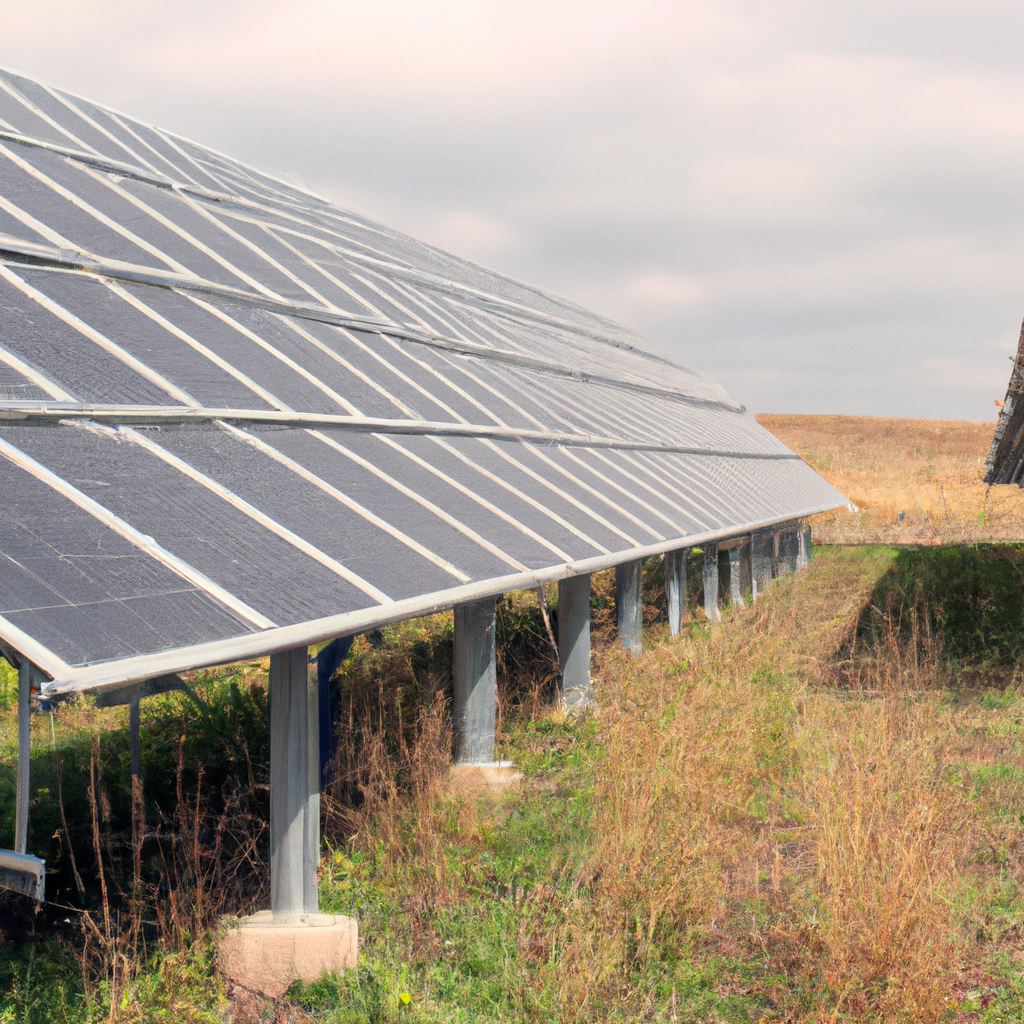
Can solar panels and row crops share the same field? New modeling work suggests the answer depends on local climate, crop type and economics.
Overview of the study
Researchers at the University of Illinois Urbana-Champaign developed a process-based model—validated with the Community Land Model v5—to evaluate how solar panels over cropland affect energy capture, water use and crop-soil interactions. They added an economic component to compare annual net profit per acre for three land uses: agrivoltaics (solar arrays over crops), conventional crop-only production, and stand-alone solar farms.
How the simulations were run
The team ran 15-year simulations across a range of Midwest climate conditions and agrivoltaic designs, assuming panels covered about one-third (33%) of each site. The framework lets users change commodity prices, land-lease rates, power-purchase terms and future climate to test real-world scenarios.
Key findings: climate drives outcomes
Average aridity versus humidity emerged as the primary factor shaping both crop responses and the economics of agrivoltaics. In humid eastern parts of the Midwest, panel shade mainly reduces light and lowers photosynthesis: simulations show maize yields falling by roughly 24% and soybean yields by about 16%, which leads to lower farm profits compared with standard row-crop farming under typical electricity revenues.
Where agrivoltaics can work
In semi-arid Midwest locations, water availability—not light—is often the limiting factor. There, panel shade reduces heat and water stress, which moderates maize losses and can raise soybean yields by around 6%. In those drier settings the combined value of crops plus electricity can approach or surpass conventional agriculture, creating potential “win-win” opportunities for soybean-based systems and solar developers.
Economic and policy barriers
Even where biophysical outcomes look promising, agrivoltaics face economic hurdles. Raising panels high enough for farm machinery and crops increases installation costs, making such projects less competitive versus utility-scale solar in many cases. The researchers note that supportive policies or tailored incentives are often needed to make agrivoltaic systems financially attractive for both farmers and developers.
Why this matters
This research provides a location-specific, testable framework for balancing food and clean-energy goals on the same land. By revealing where agrivoltaics are likely to increase or decrease farm profits and yields, the study helps planners, investors and policymakers target deployments where they bolster both agricultural resilience and renewable generation without undermining food production.
Conclusion
Agrivoltaics are not a one-size-fits-all solution. Their success in the Midwest hinges on local climate, crop choice and market rules. The University of Illinois model offers a practical tool to identify promising sites and design choices—and highlights the role policy and prices play in turning potential into practice.